
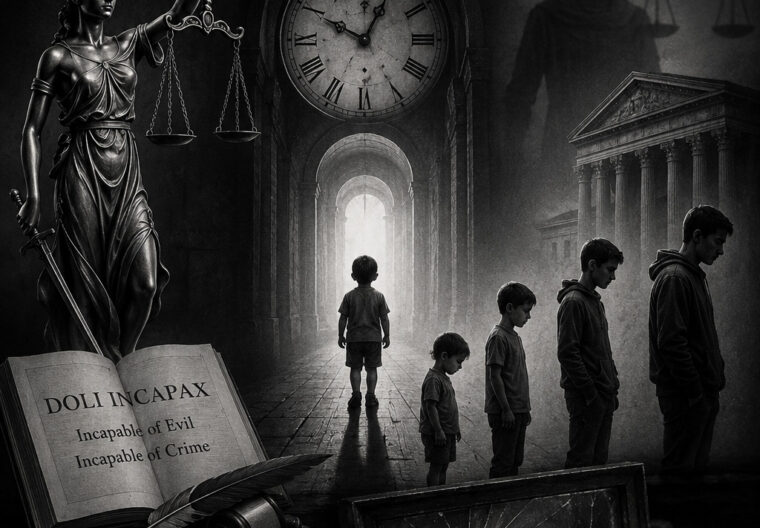
The age of innocence and the weight of intent.
There is something strange about law.It often behaves like an old clock in an empty room…always moving, always measuring, but never truly revealing what time means. In criminal law, the first sound that clock makes is simple: every person is presumed innocent until proven guilty. A principle so old that it feels almost like breathing.
But with children, the clock bends.The law does not merely presume innocence; sometimes it refuses to imagine guilt at all.
This is where an ancient Latin phrase enters like a forgotten ghost from Roman corridors— “doli incapax” . Incapable of evil. Incapable of crime. The phrase feels heavier than its translation, as if carrying centuries of doubt inside it. It creates what lawyers call an irrebuttable presumption: a child below seven is considered incapable of forming mens rea—the guilty mind necessary for crime.
Imagine it like this: a stone thrown by a child into a dark lake may create ripples, may even shatter glass on the other side, but the law looks not at the broken glass it looks at the hand that threw it, and asks whether that hand could understand destruction.
The answer, below seven, is no.Absolute immunity.
Not sympathy. Not forgiveness. Immunity.
This safeguard survives across many legal systems like an invisible umbrella over childhood.
In India, it once stood under Section 82 of the Indian Penal Code, and now breathes through Section 20 of the Bharatiya Nyaya Sanhita, preserving the same principle that a child so young cannot carry the moral weight of crime. And under Section 20 of the Juvenile Justice (Care and Protection of Children) Act, 2015, every child alleged or found to be in conflict with law must ordinarily be dealt with under the juvenile justice system, reinforcing that childhood remains the primary lens of accountability.
Between seven and twelve, however, the umbrella develops cracks.The legislation peer into the child’s mind like someone looking through rain-stained glass, asking: did this child understand what they were doing? Was there enough maturity, enough awareness, enough shape to intention?
And then comes adolescence—the hallway where childhood and adulthood pass each other like strangers.
This is where things become unsettling.Because sometimes a sixteen-year-old commits something so brutal, so deliberate, that it feels less like childhood and more like a shadow wearing childhood skin.
The Juvenile Justice (Care and Protection of Children) Act, 2015 changed the rhythm of this conversation. It said: if a child between sixteen and eighteen commits a heinous offence, the law must pause and ask harder questions. Through its framework—particularly the preliminary assessment mechanism under Section 15 and the possibility of trial as an adult under Section 18—the law asks whether age alone should remain a shield.
Not what happened?But who had happened inside that child?
The Juvenile Justice Board studies the mind like a room left in disorder—mental capacity, physical ability, understanding of consequences, the circumstances surrounding the act. And if the room looks too much like an adult’s, the child may step beyond the ordinary protection of Section 20 and into the harsher light of adult criminal justice.
A child under seven cannot commit crime because the law says evil cannot yet take root there. But an adolescent may lose that shelter if the law finds maturity growing where innocence once lived.
Perhaps justice has always been about this uneasy borderland.Not between guilt and innocence.But between innocence and awareness.
And somewhere, in a silent room, the old clock keeps ticking—not measuring years, but measuring the moment a human being first understands the weight of their own actions and consequences.
#GSLegal #LegalAwareness #KnowTheLaw #CriminalLaw #JuvenileJustice #DoliIncapax #MensRea #BharatiyaNyayaSanhita #JuvenileJusticeAct #IndianLaw #JusticeMatters #LawExplained #LegalEducation #KnowYourRights #ChildRights