
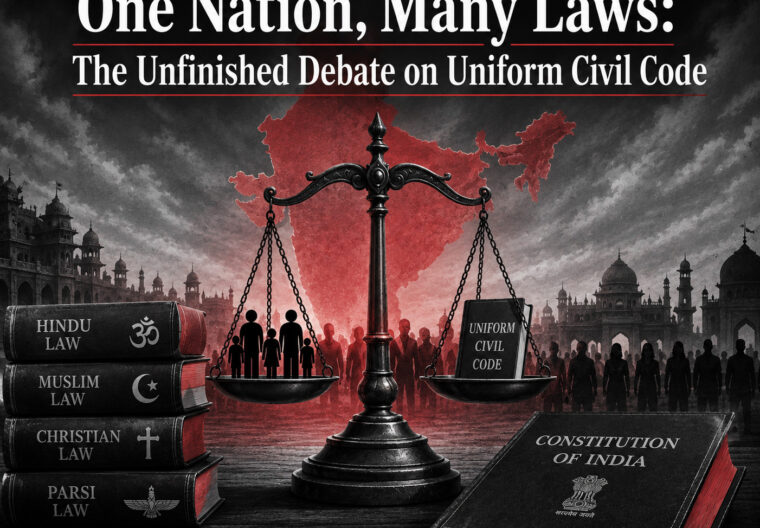
One Nation, Many Laws: The Unfinished Debate on Uniform Civil Code
Uniform Civil Code: Between Equality and Identity
India has always lived with an interesting legal contradiction. If a person commits murder, theft, cheating, or assault, the law does not ask what religion that person belongs to. Criminal law applies equally to everyone. The offence remains the same, the punishment remains the same, and the process remains the same. In that part of law, religion has no place.
But the moment the issue shifts from crime to family—from marriage to divorce, from inheritance to succession—the law changes. A Hindu may inherit differently from a Muslim. A Christian may follow a different divorce process than a Parsi. Adoption, guardianship, maintenance, and succession have never been entirely uniform in India. The rights of citizens, in these deeply personal spaces, often depend not on citizenship but on community.
This is where the debate on the Uniform Civil Code begins.
The Constitution itself anticipated this question. Article 44 speaks of the State’s duty to endeavour to secure a Uniform Civil Code for all citizens. The framers knew that one day India would have to confront the difficult question of whether civil rights should continue to be governed by religion. Yet they also understood that India was not a nation of one culture, but many.
The argument in favour of a Uniform Civil Code appears simple at first glance. If equality before law is a constitutional promise, why should marriage or succession operate differently for different communities? If criminal liability is uniform, why should civil liability in family matters remain fragmented? There is force in this logic. A common code can strengthen equality, especially for women who have often faced unequal treatment under certain personal laws. It can bring consistency, reduce legal confusion, and establish citizenship as the primary basis of legal rights rather than faith.
But the opposition to it is not without reason.
For many communities, personal law is not merely law. It is memory, faith, and identity carried across generations. Marriage rituals, inheritance customs, and family structures are often tied to religious belief. To alter them through legislation is not seen merely as reform, but as intervention into the cultural life of a people. The fear is that uniformity may become a softer word for erasure.
That is the real difficulty.
A Uniform Civil Code promises equality, but India survives on diversity. The Constitution protects both. It asks the State to move toward uniformity, but it also guarantees freedom of religion. This creates a constitutional tension that has remained unresolved for decades. Equality asks for sameness in legal rights; liberty asks for space to remain different.
The modern push toward UCC is no longer a distant constitutional dream. States like Uttarakhand have already moved in that direction, and others are studying similar laws. This shows that the idea is no longer theoretical. It is becoming legislative reality.
But perhaps the deeper question is not whether India should have a Uniform Civil Code. The deeper question is whether India can create one without losing the very diversity that defines it.
Because law does not merely regulate life. In a country like India, law often decides how much of our identity survives inside the republic.
And that is why the Uniform Civil Code is not just a legal reform. It is a test of whether equality and pluralism can truly coexist under one Constitution.
#GSLegal #LegalInsightsByGS #BeyondTheCourtroom #LawInPerspective #IndianLegalSystem #ConstitutionalConversations #UniformCivilCode #LegalLiteracy #JusticeAndLaw #LawyerKolkata