
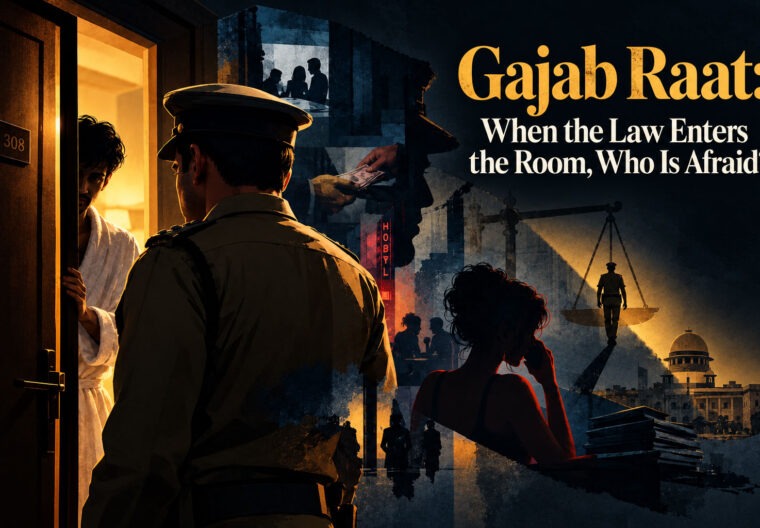
Gajab Raat: When the Law Enters the Room, Who Is Afraid?
Yes, Gajab Raat is another crime thriller/ black comedy built around a familiar predicament: a bad cop gradually realises his moral responsibilities and turns against the very system he once served. It is fiction and the transformation of its central character is part of the genre. 🎭
The opening sequence of the film is significant. A police raid is underway in a “love hotel” when the central character, the corrupted cop knocks on a room’s door. 🚪
A man emerges and when asked about his profession, that man replies that he is a lawyer. The police officer’s tone changes immediately. ⚖️
Now this small exchange reveals a larger question: if the law is equal for everyone, why should a person’s profession influence the way the police treat him? 🤔
The raid may be necessary for a lawful investigation but the authority to conduct it does not permit intimidation or unequal treatment.
The law must apply equally to everyone regardless of profession, influence or social standing. ⚖️🤝
The lawyer in this scene is not necessarily a powerful man. He is not a political authority or a person whose wealth guarantees protection. He is an ordinary individual who understands at least in principle that the law has limits. 📜
His professional identity becomes significant because it reminds the audience that a police officer’s authority is not absolute. A citizen need not surrender his dignity merely because a uniformed officer has appeared at his door. 🛡️
The legal distinction is equally important. Consensual intimacy between adults in private is not by itself a criminal offence merely because it attracts social disapproval.
The constitutional values of personal liberty, privacy and dignity protect individuals from arbitrary State interference. 🔐⚖️
Our Apex Court’s judgment in Justice K.S. Puttaswamy (Retd.) v. Union of India (2017) recognised privacy as a constitutionally protected right while Navtej Singh Johar v. Union of India (2018) reaffirmed the importance of dignity, autonomy and individual choice in matters of intimate life. 📚⚖️
Yes, none of this grants immunity from a legitimate police investigation. Where there is evidence of coercion, trafficking, sexual exploitation or another offence, the police have a duty to act in accordance with law. 🚨
But the existence of police power does not itself establish the existence of a crime. Nor can embarrassment, moral disapproval or the vulnerability of a person become substitutes for legal grounds. ⚖️
The deeper hypocrisy lies in the difference between regulating private behaviour and scrutinising public power.
The law, however must distinguish between what is unpopular and what is illegal. Otherwise, morality becomes a convenient pretext for arbitrary power. 🏛️
Gajab Raat makes this contradiction visible through black humour. 🎬
Its significance lies not in suggesting that the police are unnecessary but in reminding us that police authority is legitimate only when exercised within the law. 👮⚖️
There is, however, another irony in the film’s closing moments. After the police officer’s dramatic victory as a hero, the final scene offers comic relief through a call from his regular girlfriend, who is a professional escort. 🎭
The film thus leaves the audience with a curious contradiction. On the one hand, it celebrates the officer’s moral awakening and his decision to stand against corruption and misuse of power. On the other, its humour appears to draw upon a world in which bribery and the maintenance of an escort relationship by a police officer are treated as familiar almost routine realities. 🤔
Of course a film is a work of fiction, and a corrupt character does not represent an entire police force. Nor should every fictional scene require a statutory disclaimer explaining that it is not representative of reality. 🎥
Yet the question is worth asking: if cinema requires a statutory warning to remind viewers that smoking is injurious to health why do we not at least debate how films portray institutional corruption as ordinary or amusing? 🚬⚖️
Is it because the consequences of smoking are easier to communicate than the damage caused when public authority is casually associated with bribery and private indulgence? 🏛️💭
 +91 93303 74836

 Saraf House, 4/1 Red Cross Place, Kolkata 700001
#GajabRaat #CinemaAndLaw #LawAndSociety #RuleOfLaw #PoliceAccountability #PolicePowers #ConstitutionalRights #RightToPrivacy #PersonalLiberty #HumanDignity #EqualityBeforeLaw #ArbitraryPower #InstitutionalCorruption #AntiCorruption #LegalAwareness #IndianConstitution #SupremeCourtOfIndia #PuttaswamyJudgment #NavtejSinghJohar #FreedomAndDignity #LegalPerspective #BlackComedy #CrimeThriller #CinemaAndJustice #PublicAccountability #LegalInsights #GSlegalAndAssociates