
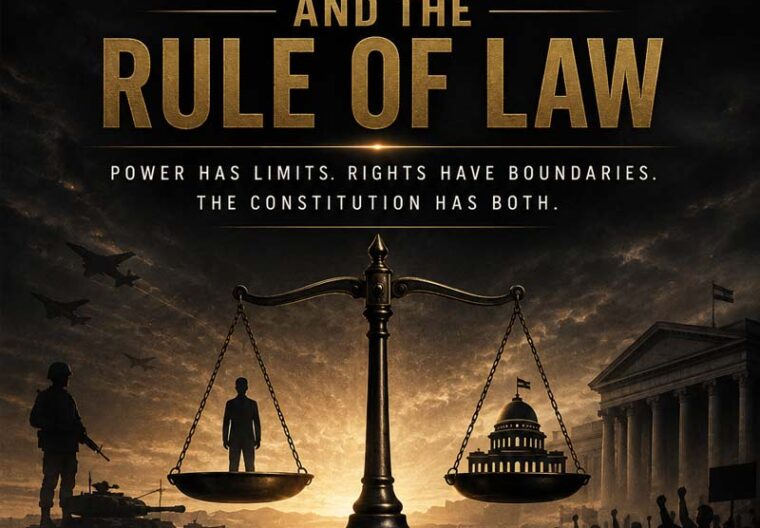
The State, the Citizen and the Rule of Law
Why Should Lawyers Care?
For lawyers, this is less a political question and more a constitutional one: how far can State power go? Can liberty be restricted? Can speech be curtailed? Can an authority act without legal power? Can a citizen challenge the State? These are familiar questions in legal practice because the rule of law is, ultimately, about keeping public power within lawful limits.
Legal practice does not operate in a vacuum. The Constitution sets the framework within which the State, its institutions and its citizens function. A lawyer’s job is not to take sides in every political argument, but to ask whether the exercise of power is lawful, reasonable and constitutionally permissible.
This is also where the Supreme Court’s constitutional jurisprudence becomes relevant. The Court has repeatedly recognised that national security and legitimate State interests matter, while also insisting that individual liberty and fundamental rights remain subject to constitutional protection.
In K.S. Puttaswamy v. Union of India, (2017) 10 SCC 1, a nine-Judge Bench recognised privacy as a fundamental right linked to liberty, dignity and individual autonomy.
In Shreya Singhal v. Union of India, (2015) 5 SCC 1, the Court struck down Section 66A of the Information Technology Act for violating freedom of speech and expression.
In Anuradha Bhasin v. Union of India, (2020) 3 SCC 637, the Court examined restrictions imposed in the context of national security and reaffirmed the constitutional protection of speech and other freedoms.
In political speeches, the State is often presented through its grandest symbols: borders, territory, sovereignty, flags, defence and military strength. These are certainly important. But the State has a much larger responsibility than protecting a line on a map.
The real question is what happens to the citizen standing inside those borders. What protects the individual’s liberty? Who protects freedom of speech? Who protects equality before law? Who protects a citizen from arbitrary State action?
Defence, territory, military strength and the constant language of national pride can produce an immediate emotional response. The political temptation is obvious: take a complex society, add a flag, a border, a military parade and a carefully chosen enemy, and politics suddenly becomes wonderfully simple.
None of this is an argument against military strength. Far from it. A capable military, disciplined armed forces and a credible defence capability are indispensable to a sovereign State. They are not matters to be trivialised or undermined; in the gravest circumstances, they are the country’s last line of defence.
The concern is not with the military itself, but with the way political leaders appropriate its image, sacrifice and institutional dignity for political messaging.
The State is not merely a security machine. Its responsibilities extend to education, health, livelihood, social justice, administration, equal citizenship and above all, the protection of constitutional and fundamental rights. The citizen should not have to become a soldier simply to be taken seriously by the State.
Constitutional democracy rests on a rather simple idea: the State is subject to law. No ruler, political party or elected majority gets a constitutional exemption simply because it has won an election. Democracy does not mean that the majority gets to do whatever it likes; it means that power remains within constitutional limits. The machinery of the State is ultimately meant to serve the citizen, not to manufacture emotions for political consumption.
Question the government, and you may be called anti-national; question military policy, and the discussion can suddenly become a test of patriotism.
The citizen is then invited to feel first and ask constitutional questions later.
This is why a constitutional democracy must distinguish between patriotism and political obedience.
Loving a country does not require loving every government that happens to occupy its offices. A citizen’s duty is not to applaud every official decision.
The right to question power is not an act of betrayal; it is one of the privileges—and responsibilities—of citizenship.
The deeper danger appears when nationalism needs a permanent “enemy” to keep itself politically useful. An external enemy may be convenient; an internal enemy can be even more convenient. Once dissent becomes disloyalty, criticism becomes treason and constitutional rights are presented as obstacles to national strength, the priorities of the State have quietly been rearranged.
History offers enough warnings about what happens when these habits become normal.
Authoritarian movements have repeatedly relied on the elevation of the State above the individual, glorification of national identity, suppression of dissent and the creation of permanent enemies. Nationalism and fascism are not legally synonymous, but nationalism can become a convenient vehicle for authoritarianism when national identity is placed above constitutional rights and institutional restraints.
The legal question, therefore, is not simply whether the State is strong, but whether the State knows what it is meant to protect—and where its power stops.
A genuinely democratic State does not earn legitimacy merely by possessing borders, armed forces, official seals and a very impressive vocabulary about national interest. Its legitimacy rests on the Constitution, the rule of law and the rights of the people.
The flag may unite us, the border may define us, and the military may defend us—but the Constitution is supposed to protect us.
The military deserves respect, not political repackaging. In a democracy, that distinction matters.
The State derives its democratic legitimacy from the people. Government exercises power on their behalf. And neither gets to stand above the law.
#TheStateTheCitizenAndTheRuleOfLaw #RuleOfLaw #ConstitutionOfIndia #IndianConstitution #ConstitutionalDemocracy #FundamentalRights #CitizenRights #ConstitutionalRights #Justice #LegalAwareness #LegalInsights #LawAndJustice #ConstitutionalLaw #PublicLaw #HumanRights #FreedomOfSpeech #EqualityBeforeLaw #Liberty #Dignity #StatePower #Accountability #ConstitutionalGovernance #Democracy #DemocraticValues #RuleOfLawMatters #LegalProfession #LawyersOfIndia #IndianLaw #KolkataLawyers #GSLegal #GSLegalAssociates